Product Marketing Debunked
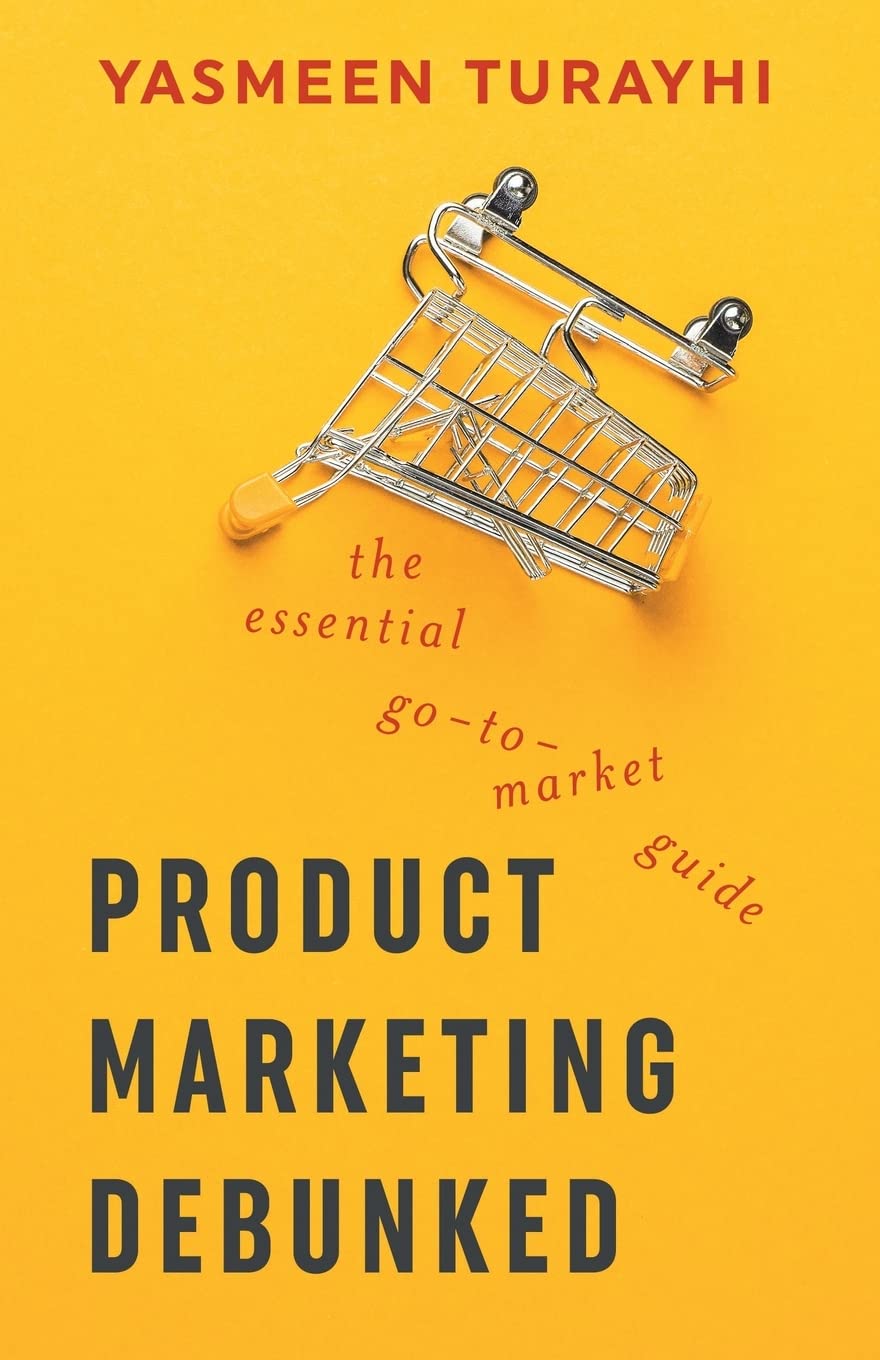
Another book I found on a product marketing suggested reading list was Product Marketing Debunked by Yasmeen Turayhi. The book covers provides a framework for commercializing products, with an emphasis on product marketing's role in creating effective go-to-market (GTM) plans for new or early-stage ideas. It's a short read and split between outlining what roles product marketers typically play, including when they should be hired, and outlining a GTM framework for new products, including templates for typical deliverables and artifacts.
Why You Need a Product Marketer & What They Do
The goal of a product marketing manager is summarized as follows:
deliver the right product to the target customer at the right time to ensure customer adoption
Product marketers are responsible for customer research and validation from alpha to launch, the GTM plan, building the value proposition, competitive intel, and the marketing programs necessary to launch. In the early days of a start-up, product managers (or the founders themselves) often cover these responsibilities. But over time as they have less bandwidth to do both jobs, it definitely makes sense to have a dedicated PMM. It's also important to note that PMM's are distinct from brand marketers, demand generation, and growth marketing.
If you're a PMM brought on in a contract or full-time capacity, Turayhi's recommended a 3 phase process to get up to speed.
Phase 1: Clarify the Company's Overarching Business Goals
As a new PMM or a founder starting your venture, you should aim to answer the following questions. If you aren't able to answer them, you're likely headed in a direction that is wasting your time.
- What is the company's mission?
- What are the overarching business goals?
- What initiatives are they pursuing in the quarter and year ahead to achieve those goals?
- What does success look like 3-6-9-12 months from now?
- What gaps exist that may prevent the company from reaching its goals?
- Is there time, capital, and an openness to additional testing for an existing product roadmap?
- Where operationally or strategically can I make changes?
- How do they want the brand and company to show up in the market?
- What is the core culture of the company? Is it product-led? Marketing-led? Design-led? Or governed by some other underlying value system?
- Who are the key decision makers?
Phase 2: Assess the Stage of the Product's Growth Cycle
You should then try to assess what growth stage the company or product is at.
By Product / Funding Stage
One way to think about this is how the job often varies by company/product stage.

By Inbound, Outbound, & Field Enablement
Another common way is to differentiate them by inbound or outbound focus.

Phase 3: Uncover Where You Can Make the Biggest Impact
Determine what you can do to make the biggest impact on customer adoption. This is varies depending on what stage the company is at and what your focus is.
When to Hire Product Marketing
The primary mistake company's normally make is bringing a PMM on reactively after something has failed. Most likely the failure was a strategic one that could have avoided (or at least mitigated) the customer adoption issues you're now facing. The best time to bring on product marketing is likely around the same time you're hiring for product management. They are the counterpart to product management.
3 Steps to Launching a Product
Step 1: Market Validation
Initial Discovery and Validation
First step is to test your product hypothesis with a target audience. This can be easily done with a survey. Keep it to 10 questions max and be sure to include whether someone would pay for the solution and for how much. Get an idea of different customer segments and then conduct around 5 customer interviews with each segment to really understand pain points. These early interviews are likely also your first customers.
Market Sizing
Do some simple math to get an idea of the size of the market you're targeting.
Mapping the Industry
You want to create a map of the industry with the goal of gaining an understanding of competitors, alternatives, adjacencies, and complements to what you're working on. Common deliverables here are "market maps" or SWOT analyses comparing your solution to alternatives.
Customer Research
Next, you'll want to do a deep investigation via customer and ecosystem interviews to understand the psychology of everyone in the ecosystem - what their business goals are for the year, how they currently solve the problem, what other solutions do they use that are adjacent or complementary, how they find solutions, how they make purchase decisions, etc. You can conduct just 5 - 7 interviews, but they need to be really deep and very representative. Your early adopters are the best candidates.
Prioritization
Based on your research, you'll then prioritize a set of features for your target customer. This should be a cross-functional exercise as small features may end up being a key differentiator for positioning. For each feature, you could rate the following to help you create a balanced score to prioritize:
- cost
- time-to-market
- effort
- market impact
- innovativeness
Validation
You'll iteratively build versions of the product and test them with a small subset of customers (likely the same ones you interviewed) to validate your hypothesis and understanding of the need.
Marketing Requirements Document
Some companies may require you to produce a Marketing Requirements Document (MRD) that covers the following:
- Company/product plan and strategy
- Customer insights and user profiles
- Competitive matrix with various feature sets
- Market segmentation
Step 2: Framing the Message
After market research and creating the MRD, product marketers distill the learnings and translate them into a positioning document that is shared across teams and leadership with the goal of establishing buy-in, providing a master document to use in creating product and marketing assets, and ensuring consistent branding and messaging.
Positioning
A positioning document usually has the following components:

Messaging Framework
You can then create a framework to help guide messaging. Start with the overall value proposition. Below that are the unique benefits supporting the value prop. And below each benefit are the pillars (features, proof points), that support the benefit.

Packaging & Testing Your Message
Turayhi's definition of "packaging" is a little different than what I'm familiar with (which is normally bundling). For her, packaging appears to be putting the positioning into a story form. The customer is at the center of your messaging, where the customer is the "hero" in the hero's journey. It's important to test your messaging with customers in the market to see what resonates best and leads to trial and activation.
Step 3: Go-to-market and Delivering the Message
What is Go-to-Market?
A go-to-market (GTM) plan is the strategy for how a company plans to reach customers within a given market to ensure customer adoption. Before launching, it's important to have an owner that will track revenue drivers, both price and volume, along with specific growth and margin drivers.
5Ws + H of a Product Launch
GTM answers the following questions about the product launch:

Product Launch Template
Well in advance of product launch, you can get all stakeholders aligned on the launch using a product launch document.

Owning the Funnel
Product marketers own the entire funnel and are responsible for creating assets that move customers through the funnel to purchase. Whether that's working with demand generation via buyer personas, product pages, and webinars or product demos, sales enablement materials, and email campaigns to drive conversion and purchase. You identify where in the funnel customers are getting stuck and you adjust content and tactics accordingly to get them unstuck.

Enablement and Launch
You'll also want to create a distribution strategy and support plan that includes the following:
- Enablement: How is the company going to internally support and operationalize this product?
- Product setup-up and internal activation
- Sales training
- Customer success training
- Internal stakeholder training
- Distribution: channel plan for product awareness and activation
- Press
- Social media
- Blog
- Email product announcements
- Webinars
- Conferences
- Paid media
- In-app product growth plans
- Partner outreach
- Influencer strategy
- Referrals
- Retention
- Email campaigns / drip campaigns
- Social media
- Incentives
- Promotions
- Return customer campaigns


Comments